I've changed my avatar, come and take a look~

Adults only (18+). By entering you confirm you are at least 18 years old.

Based in: South Korea, Busan. Rather lack than settle Height 180cm Weight 87kg Cancer
I've changed my avatar, come and take a look~
An S who can keep his M is not just about wielding a whip, nor only satisfying physical desires. A long-lasting relationship must be your personal charm. You change for each other. Although preferences are mainly the S's, if you only consider yourself and don't care about the M's preferences, in the end you cannot make him produce dependence and trust. The circle as I understand it is roughly: companionship, discipline, TJ A person willing to spend time accompanying you must like you; a person willing to discipline you must hope you become better; a person who wants to TJ you must recognize your facial features and appearance. When you meet a person who fits these three points, then you are a lucky M; he didn't treat you as a toy, but is wholeheartedly being your S

Code for being an M Mu 1. Except for family, the master is first. 2. Report your itinerary every day, let the master understand your movements. 3. Share daily life with the master, don't worry you're annoying; the purpose is to let the master enter your world. 4. Morning and evening greetings are the most basic etiquette, no need to say more. 5. Accept the master's preferences; what you can't accept, slowly accept it. What you truly can't accept, communicate with the master. 6. Communicate at any time if there is any problem, don't bury it in your heart; long-term accumulation will create a gap with the master. 7. Trust your master. 8. Your psychological state needs to let the master know; some tiny changes, emotional instability — you must not think wildly, talk more with the master; the master hopes you happily accompany the master every day. 9. You cannot make requests to the master, such as "hope the master.…" "want the master…" "want to be by someone…" As a dom I don't like being arranged; as a Mu, you can only request, beg the master to do something to you; at other times you can only be at the master's disposal, reward, giving, punishment. 10. After being taken in by the master, you cannot participate in any circle gatherings or activities; if you want to participate the master must be present; you cannot privately communicate or meet with other S in the circle; anyone who wants to communicate must go through the master's consent. In the chat box, pin the master to the top. 11. Think more for the master, work harder to do something for the master, rather than just talking; everything should have a response, every matter should have a result. 12. Remember the master's preferences. 13. You cannot lose contact or break contact; before you're busy you must tell the master what you're busy with; after you're done, report back at the first moment.

The wise solve problems, the foolish vent emotions, The weak are easily angered like tigers, the strong are calm like water, Those who achieve great things are not trapped by feelings, not disturbed in heart, In shocking waves they sit steadily on the fishing platform, In complicated worldly affairs they see clearly like watching fire, Mount Tai collapses before them and their color does not change, A deer rises to the left and their eyes do not blink, This is the demeanor of the strong!

The tamer/trainer, using gentleness as a guide, follows propriety to lead, retracts sharpness and holds compassion, not forcibly dominating and binding, but with a transparent heart-nature, slowly settling each other's rhythm; The compromiser, basing on sober self-holding, knows advance and retreat and is good at yielding, not humbly submitting, but a fulfillment with measured choices and an undiminished original heart. The two fit and blend together, reflecting each other between restraint and tolerance, a same-frequency fit deep in the soul, and a deep bond that keeps propriety and holds reverence in the heart.

As a high-quality male Dom, I will build you into a high-quality, mature and charming woman. The following ten aspects are my transformation plan and goals for you; follow me and slowly become better together: Emotionally stable, no internal friction Don't panic when encountering things, speak well even when angry. It's not having no emotions, it's knowing how to digest them, not casually dumping them on others. Have your own opinions, don't follow the crowd What to wear, what choices to make, you have your own judgment. Don't blindly follow trends, and don't live in others' evaluations. Economically independent, spiritually even more independent Can pay for yourself, and can carry things yourself. Don't place your sense of security on anyone, instead make people want to get closer. Know the ways of the world but not be worldly Understand human relations, but don't be smooth and flattering. Can be gentle, also have edges; bottom lines clear and gently held. Speak with propriety, listen with patience Don't randomly interrupt others, and don't easily judge. Speaking makes people comfortable, silence also makes people feel at ease. Accept your own imperfections No longer obsessed with 'girlishness,' reconcile with wrinkles and small changes in figure. Confidence starts from accepting your true self. Have passions, life has light Outside work, have things that make your eyes light up — reading, growing flowers, traveling, painting... Don't stake your whole life on a relationship. Strong sense of boundaries, don't flatter and don't entangle Don't interfere with others' karma, and don't allow others to cross boundaries. When it's time to refuse, be decisive; when it's time to let go, don't drag mud and water. Eyes have stories, smiles have openness Experienced wind and rain, but not ground into hostility by life. Sincere when looking at people, relaxed when smiling. Know how to love yourself, also know how to love others First take good care of yourself, then have spare strength to warm others. Don't control, don't depend; in a relationship be both independent and intimate.

You don't have to be emotionally stable forever, please allow emotions to flow I know you don't want to talk now. It's not that you have nothing to say, it's that saying it is useless. It's not being dramatic, you're really tired. It's that kind where clearly nothing happened, but your heart just feels heavy, like it's filled with lead, like something is pressing on you, and you can't breathe evenly. You smiled again today. Smiled at colleagues, smiled at the courier, and when calling your mom you deliberately brightened your voice. You acted so well, so well that even you almost believed it — I'm fine, I'm pretty good. But the moment you closed the door, the expression on your face came off. Not slowly, but with a snap, your whole person collapsed. You sit on the sofa, the light isn't on, your phone lit up then dimmed, you didn't look. You know who it is, but right now you don't want to reply to anyone. It's not that you don't care, it's that you have no strength to care anymore. You hate this version of yourself. You feel why are you so useless. Others can carry through when they encounter things, why do you want to shrink back as you carry on? Others post positive energy on Moments, why do you need half a day of mental preparation just to get up? Others say "emotional stability is top-level cultivation," you can barely spell the word stable. You start judging yourself. — Am I too sensitive? — Is my stress resistance too poor? — Should I see a psychologist but feel it's not serious to that degree? — Am I just being dramatic? You think about these over and over, and the more you think the more you feel there's something wrong with you. Then you're even more tired. I want to tell you one thing. What you're experiencing now is not because you're not good enough. You are not fragile. You are not poor at resisting stress. You are not being dramatic. You just haven't let yourself rest for too long. You've been outputting all along. Outputting professionalism to your boss, emotional value to friends, sensibleness to family, thoughtfulness to your partner. You're like a customer service always online, saying to the whole world "okay" "no problem" "I can." But no one has ever asked you — are you tired? No one asks, and you don't ask yourself either. Because if you ask you have to face the answer, and that answer you dare not touch. You're afraid that once you admit you're tired, you'll collapse. Afraid that once you stop, you'll never be able to move again. Afraid that once others see you not doing well, they won't like you anymore. So you keep holding on. Keep smiling. Keep pretending you're fine. But today, right now, when you see these words — You can stop holding on. You don't need to act in front of me. You don't need to prove you're strong. You don't need to tidy up your emotions cleanly before you deserve to be loved. You don't need to wait until you're "better" to qualify to be understood. The way you are now, dusty, listless, wanting to cry but unable to, interested in nothing — This way is just fine. Not the kind of "it will get better" fine. It's now, like this, just fine. You don't need to be fixed. You don't need to be saved. You don't need someone to give you a bowl of chicken soup and pat your head saying cheers. You only need someone to see you. See that you're not lazy, you're really out of battery. See that you're not acting up, you're really uncomfortable. See that you're not not trying hard enough, you've already pushed yourself to the limit and still blame yourself. I see it. You don't need to speak, I know everything. Today you don't need to do anything. Don't force yourself to be positive, don't force yourself to cheer up, don't force yourself to figure it out. Just stay there. Lying down is fine, daydreaming is fine, throwing your phone away is fine. You haven't been left behind. You haven't fallen behind. You just walked a little slower today. Tomorrow's things, talk about them tomorrow. The day after tomorrow's things, talk about them the day after tomorrow. Tonight, you do just one thing — Stop scolding yourself. Just this one thing. That's enough.
The essence of adults is to choose those with high compatibility, then enjoy the spiritual pleasure and physical blending each brings; as for how long you spend together, leave it to fate. Good night, this world of both light and darkness. #FemaleDomMaleSub# #MyUnderstandingAndKnowledgeOfSiMu#

Everything can be taken from a man but one thing: the last of the human freedoms—to choose one's attitude in any given set of circumstances. Translation: Everything a person possesses can be taken away, except for the last freedom of human nature — the freedom to choose one's own attitude in any situation — cannot be taken away. From Viktor Frankl's 'Man's Search for Meaning'

In the heart there is submission In the eyes there is reverence In thought there is obedience In action there are rules and discipline

There is a kind of relationship where you can 'fall down' in front of him. Not falling over, it's that you finally don't have to hold yourself up. No need to maintain that 'I'm fine' decency, no need to trim your emotions neatly before going out. When you're tired you can lean on him and daydream; when you're feeling down you can say nothing and he just sits quietly beside you; when you break down you can cry very ugly, he won't take a photo to post on social media, and won't turn and walk away. The way you look when you fall down, he's seen it all. And then he's still standing there. This is the beginning of nourishment — you don't have to perform anymore. Have you noticed that getting along with some people is especially tiring? Not because you're incompatible, it's because you've been acting all along. Acting happy, acting sensible, acting 'I don't care,' acting 'I'm fine with anything.' You compress yourself into a shape he might like, stuff yourself in, and after a long time you forget your original outline. But with the right person, you unfold bit by bit. Like a plant moved into the sunlight, leaves opening one by one, color deepening day by day. You start to tell the truth, start to express dissatisfaction, start to say 'I don't like this' instead of 'whatever.' You even start to expose those parts you thought were ugly — your controlling desire, your insecurity, your 3 a.m. wild thoughts. He saw it. Didn't run. He just said: 'Oh, so you can be like this too.' There was no dislike in his tone, only the solidity of 'I finally understand you better.' This is nourishment. It's not him praising how great you are every day; it's him seeing your bad places and still feeling you're worth getting close to. And you are the same. When he's clumsy you don't laugh at him, when he's vulnerable you don't use it as a handle against him. His occasional childishness, occasional stubbornness, occasional laughable 'straight-man thinking' or 'absent-minded operations' — it's not that you don't see them, it's that you see them and think — pretty cute, this is him. Between you there is a thing called allowing. Allowing the other person to be immature, allowing the other person to occasionally drop the ball, allowing the other person to simply be worse than you in some aspects. You don't use that as a weapon, don't bring up old accounts, don't throw it out during a fight. You both tacitly know: those imperfections are part of this person; if I accepted the good, I have to accept this. This is not compromise. This is choice. Choosing a person is not choosing his highlight moments, it's choosing his most ordinary daily life — choosing his stinky face after getting up, choosing the night his cooking fails, choosing his silly look when his eyes light up talking about something he likes. This
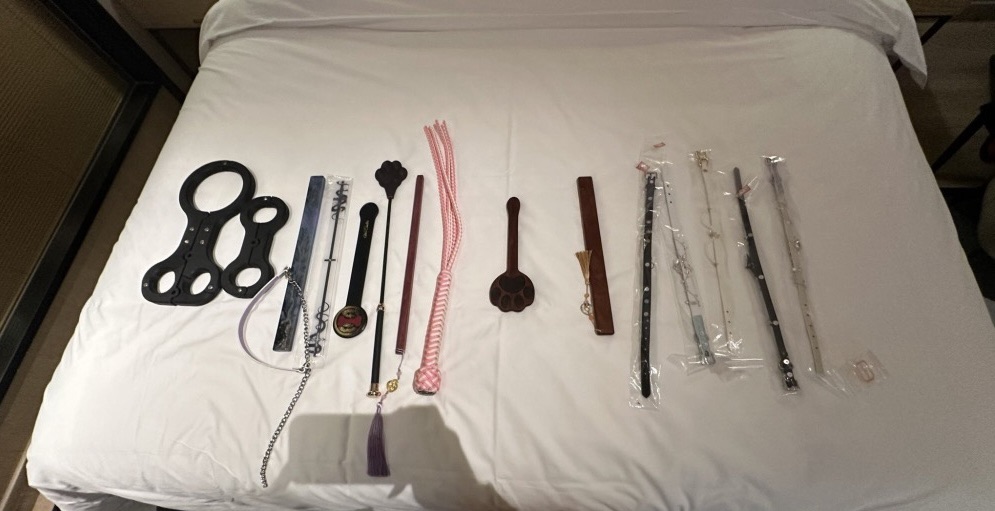

Kneeling on the ground as a Mu, standing up as a friend
What a healthy Si-Mu relationship looks like Many people think the core of a Si-Mu relationship lies in technique, intensity, or who is more 'professional.' Actually not. Strip away all labels and props, and a healthy Si-Mu relationship is tested by the same set of standards as an ordinary intimate relationship — it's just that its concentration is higher, so problems are exposed faster. Trust is earned, not demanded In a Si-Mu relationship the granularity of trust is much finer than in ordinary relationships. A person entrusts their body and vulnerability into your hands; this isn't covered by a single sentence 'I trust you.' Healthy trust is what a Dom saves into the account bit by bit, every time he holds back, every time he stops at the edge, every time aftercare is present. A Sub dares to call stop because past experience repeatedly tells him: after calling stop it's safe, he won't get a cold face, won't be told 'you don't trust me enough.' An unhealthy signal is trust and fear mixed together. 'I don't dare not obey him' being taken as 'I trust him' — these are two different things. And there's that kind of using existing consent to extort more — 'You already let me tie you up, why not that' — past consent cannot be overdrawn into permanent authorization. Trust has layers. Body safety is one layer, emotional safety is one layer, sexual preferences are another layer. Each layer is built separately; you don't automatically get all permission just because 'you already let me do this.' Boundaries are alive, not carved in stone Hard boundaries and soft boundaries both count. Hard boundaries are absolutely not to be touched, no need to explain why. Soft boundaries depend on mood, confirm on the day, allow them to change. A healthy dynamic is: after a boundary is respected the relationship is better, not 'you killed the mood.' A Sub says 'This place won't work today,' and the Dom's reaction is 'Okay, then let's change to another' — rather than 'You were fine last time, why not this time.' The most hurtful sentence after a boundary is broken is 'You wanted it yourself.' Consent can be withdrawn, especially when body and emotional states change every day. Using past consent to kidnap the present refusal is not a relationship, it's control. Power is lent out, not sold This is the most core point. What a Sub hands over is the right of use, not ownership. When the scene ends, take it back. A Dom's power has a term, a scope, and conditions. It's not 24/7 with no dead corners. The greater the power, the heavier the corresponding responsibility — aftercare, emotional holding, communication before the scene, observation during the scene — these are all the price of a Dom's 'privilege.' An unhealthy pattern is control spilling from the bedroom into all of life. A Sub is managed in what to wear, who to meet, how much money to spend, and leaving is described as 'betrayal' or 'ingratitude.' At this time the role is no longer a role, it's a prison cell. A healthy pattern is: In the scene you are a sub; out the door you are a complete person. A Dom in the scene is the superior, but in the relationship he is not 'always right.' Roles do not cancel personality, agreements do not override dignity. Aftercare is not a bonus item, it's a bottom line Ordinary relationships need repair after a fight. In a Si-Mu relationship the chemical changes the body and brain experience are more intense, the emotional labor denser, and someone is even more needed to catch you. Aftercare after a scene ends is the responsibility of both parties, not a sub unilaterally 'needing to be cared for.' A Dom may also need aftercare — controllers also have drops, they are just less used to speaking up. Emotional aftercare is harder than physical aftercare. Water, blankets, hydration are basic, but 'Are you okay,' 'What did that mean to you just now,' 'I see you' — these are what truly ground a person. An unhealthy signal is 'leave as soon as it's done' being treated as cool, or a sub dropping being told 'you're too sensitive.' Whether your real experience is taken seriously in this relationship is the bottom line. Communication is daily, not only done when something goes wrong Si-Mu relationships force people to do communication well because the risk is higher. But many relationships narrow communication into 'talking about boundaries' — actually it's far more than that. Daily communication includes: how is your state today, what in recent life is draining you, does this relationship make you feel nourished or depleted. Communication before a scene is 'what do I want to do today, what don't I want to do, where is my body uncomfortable.' Communication after a scene is 'what was good, what could be different, was there a moment that felt wrong but I didn't say.' What is most feared is communication becoming one-sided self-criticism. The Dom decides, the sub can only execute and reflect — this isn't communication, it's reporting. Equality is hidden under the roles Roles are unequal, but people are equal. This is where Si-Mu relationships are most easily misunderstood and most prone to problems. A healthy sign is both parties can speak up, can refuse, and their needs count. A Sub in a scene hands over control, but what is handed over is at the behavioral level, not the thinking level. You can still ask 'why,' can say 'I want to try this,' can participate in designing your dynamic. An unhealthy sign is a sub gradually cutting off all social ties and only revolving around the Dom, or the Dom's life is rich and colorful while the sub's world gets smaller and smaller. One side is growing, the other marking time, the gap getting bigger and bigger. The test method is simple: Does this relationship make you bigger or smaller? In this relationship are you still a complete person? Growth is a matter for two people Si-Mu relationships have many experiential channels ordinary relationships don't. A Sub in submission can learn trust, learn to get along with the body, learn to express real needs. A Dom in control can learn to read people, learn restraint, learn to bear another person's vulnerability. But these don't happen automatically. Both sides need to consciously digest, discuss, integrate. What is most feared is the relationship becoming repetition — the same script performed a hundred times, no new things, no deeper understanding, just pushing the stimulation threshold higher and higher. A healthy Si-Mu relationship should be nourishing you. You walk out of it feeling a bit more complete, understanding yourself a bit more. If a relationship makes you increasingly dependent, increasingly closed, increasingly feeling you can't live if you leave — that's not intimacy, it's addiction.
